Great Dane
The FriendThe Great Dane enters the book not as an abstract breed profile but as Apollo: a harlequin dog of extraordinary size, found alone and taken in after efforts to locate his owner failed. His physical presence alters the Narrator’s routines, living arrangements, and encounters with strangers, while his grief and vulnerability complicate the assumption that an animal is merely an object of human care. Through Apollo, the breed’s imposing appearance is set against its reputation for calm and sweetness, and the book keeps returning to the gap between what humans observe and what they can know of a dog’s inner life.
Breed and Appearance
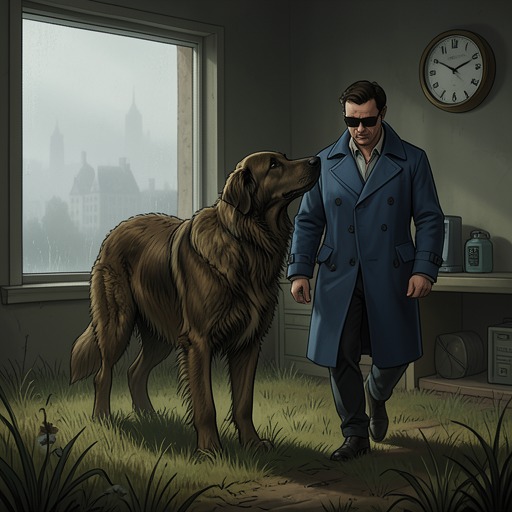
Apollo is described as a harlequin Great Dane, with no collar or tags when the Narrator finds him. At thirty-four inches from shoulder to paw and a hundred and eighty pounds, he is the largest dog the Narrator has ever seen; in an attached photograph, his massive head can initially be mistaken for a pony’s. His size makes the breed immediately legible to other people, but not necessarily as a threat: Apollo becomes a neighborhood wonder, startling some passersby and drawing the attention of others.
The book distinguishes the breed’s imposing scale from its temperament. Great Danes can exceed two hundred pounds and stand more than seven feet tall on their hind legs, yet are described as known not for ferocity or aggression but for sweetness, calm, and emotional vulnerability. The familiar epithet gentle giant gathers that contrast into a phrase. Apollo’s own conduct does not simply dissolve the contrast: his body is conspicuous and powerful, while his distress can make him seem painfully small.
The breed’s name and history are treated with some skepticism toward tidy labels. Its precise origins are unknown, and the mastiff is identified as its closest relation. Despite the word Dane, the name is attributed to a mistaken eighteenth-century French naturalist, Buffon; the English-language name endured, while in Germany the breed is called the Deutsche Dogge, or German mastiff. Its history includes breeding for wild-boar hunting and later use as a guard dog. The text also recalls Otto von Bismarck’s affection for the Dogge and the Red Baron von Richthofen’s habit of taking his dog in a two-seat plane, details that place the breed in markedly different settings from Apollo’s apartment and city streets.
Apollo’s Arrival and Care
The Narrator finds Apollo early one morning while out running. He stands silhouetted on an overhang, without a collar or tags. Although he appears purebred, the absence of identifying information leads the Narrator to consider that he may have been abandoned. After trying to find his owner and failing, the Narrator decides to keep him. Apollo’s original owner is later described as having died suddenly, leaving no one else to take the dog; the Narrator initially explains the arrangement as temporary.
The practical burden of caring for such a large animal appears in the daily walk. Apollo is always kept on a leash, but he sometimes squats dangerously close to the curb. The Narrator positions themself between him and oncoming traffic, reasoning that drivers may be more careful to avoid a person. Some Manhattan drivers curse the inconvenience; other pedestrians slow down to stare. Cleaning up after Apollo is another public performance: the Narrator uses a child’s sand pail lined with a plastic bag and a small garden trowel, while strangers comment on the size of his droppings. The equipment that makes care manageable also becomes a source of public amusement.
The Narrator connects these walks to a discussion of flânerie. The deceased friend had argued that walking a dog was not genuine aimless wandering, because responsibility for the animal interrupted abstraction. The Narrator now finds that Apollo’s presence draws so much attention that thinking becomes difficult for a different reason. The dog is not simply a companion carried along through the city: his needs and visibility organize the walk, determine how the Narrator moves, and expose them to scrutiny.
Grief, Aging, and Animal Subjectivity
Apollo’s life with the Narrator follows the loss of his previous owner and multiple changes in his surroundings. A veterinarian accepts that the dog may be mourning that owner and says environmental upheaval could have intensified his emotions. The Narrator reports that Apollo howls and sometimes has episodes in which he looks around as if bewildered, clamps his tail between his legs, crouches close to the floor, and shakes uncontrollably. The episodes last from a few minutes to as long as half an hour. The account does not make Apollo’s inner experience fully knowable, but it treats his fear and bereavement as serious possibilities rather than dismissing them as mere projection.
The same veterinarian warns that Apollo, though in fairly good shape for his age, is unlikely to be long-lived; given his arthritis, the veterinarian adds, he would not want to be. Apollo is already about five, and the Narrator’s deceased friend’s wife says a Great Dane’s life span may be only six to eight years. The breed’s limited life expectancy gives the decision to take him in a particular weight: care is understood from the outset as finite, but not therefore disposable.
The Narrator also grieves for the life of Apollo that began before their meeting. They feel cheated not to have known him as a frisky young dog and not to have a photograph of his puppyhood. Instead, they spend hours looking at harlequin Great Dane puppies in books and online. On one walk in SoHo, the Narrator encounters another person walking a harlequin Dane. The humans are delighted by the coincidence, while the dogs look past one another. The scene resists the easy expectation that shared breed will produce recognition or fellowship between animals.
Naming, Public Rules, and Representation
Apollo’s name links his grandeur to a fact the Narrator later encounters: Great Danes are known as the Apollo of dogs. The Narrator cannot tell whether the deceased friend chose the name for that reason or by coincidence. Several alternatives had been considered before the dog was named, but Apollo’s dignity seemed to rule out the earlier choice of Dino. The Narrator likes the final name and would not change it, while recognizing that when Apollo responds, he may be responding more to a familiar voice and tone than to the word itself. Naming expresses human attachment, but does not prove that the animal receives a name as humans do.
Apollo’s size also makes concealment impossible when the Narrator brings him into an apartment building whose lease prohibits dogs. The building superintendent, Hector, says the dog cannot stay, even temporarily. The Narrator recalls being told of a New York City rule under which a tenant who keeps a dog openly for three months without the landlord taking action may keep the dog and cannot be evicted for doing so. Because Apollo is walked several times a day and is widely visible, the requirement that the dog’s presence be open is not an abstract condition. The building’s management later sends a warning that Apollo must be removed immediately or the Narrator will be in violation of the lease.
A certificate identifying Apollo as an emotional support animal eventually changes the dispute’s course. The Narrator sends a copy to the building’s management agent but promises not to use the certificate to take Apollo into places where dogs would not ordinarily be allowed. Hector later brings word that the agent has advised the landlord not to contest the request for Apollo to remain, particularly since other tenants have not complained. Relief follows, but the Narrator rejects the idea of using the certificate again for a future dog, unwilling to think of Apollo as replaceable.
Apollo’s breed also changes as the book turns from lived experience toward fiction. In a conversation about adapting life into a story, the deceased friend’s dog, initially called Jip, is described as becoming a Great Dane in the fictional version, while the detail of finding him in a park is retained. This transformation makes the breed part of the book’s inquiry into how real people and animals become literary characters: some details persist, others change, and exaggeration makes a character distinct without preserving a complete life. Across these contexts, the Great Dane is at once a particular animal whose care requires daily attention and a figure through which the limits of naming, representation, and human understanding remain visible.